Tomorrow, the opening of the P5+1 (Permanent Members of the Security Council + Germany)-Iran talks is likely to produce few significant changes. Instead, the P5+1 will likely seek assurances that Iran’s nuclear program is intended for peaceful purposes, Iran works with the International Atomic Energy Agency (IAEA) to resolve outstanding issues, and Iran takes a much more transparent approach with its nuclear program. Iran, on the other hand, is likely to try to shift the emphasis to broader issues outside the scope of its nuclear program.
In part, Iran’s incentive to remain intransigent is the result of its calculation that no severe sanctions are likely. Instead, because Iran’s economy is not highly integrated with the world’s major economies, sanctions concerning oil industry parts or financial flows are likely to have only a limited adverse impact. With Iran recently entering into an agreement to purchase refined petroleum products from Venezuela, a sanctions regime that deprives Iran of such products is also unlikely to be very effective. The single sanction that could break Iran, namely its ability to sell oil on the world market, is highly unlikely.
Briefly, it is that sanction that would hold the best promise of breaking Iranian rigidity for several reasons:
• Petroleum accounts for 80% of Iran’s exports. Oil revenue amounts to 113% of Iran’s imports. Without oil revenue, Iran’s current account deficit would explode.
• Just five countries account for nearly 72% of Iran’s oil exports: Japan, China, India, South Korea, and Italy.
• Venezuela, with which Iran has been steadily deepening relations, is an oil exporter and would be unlikely to purchase crude oil from Iran.
• A shutdown of Iran’s oil sector would exacerbate that country’s 12.5% unemployment rate.
However, to bring the small number of countries, including China, into alignment on a severe sanctions regime that targets Iran’s oil industry would likely require the United States taking measures to assure their access to oil at a reasonable price. One mechanism that could be explored would entail the U.S. committing to sell oil from its strategic petroleum reserve at a discount from world prices to buffer the impact of the loss of Iranian oil on those countries. Although such an approach is not assured to produce the commitment to such a sanctions regime, should it become necessary, it could constitute a step in that direction.
Beyond diplomacy, the policy options involved become much less pleasant. One such option would constitute the construction of a credible deterrent e.g., in the form of a U.S. commitment that would translate into Iran’s destruction were Iran to launch or attempt a nuclear strike and/or proliferate nuclear weapons. Even then, the Middle East’s balance of power would be dramatically altered on dimensions concerning state power, the capabilities of non-state actors, and in terms of the Sunni-Shia rivalry. Another option would entail military strikes. Such strikes would likely be costly considering the need for some ground component to destroy buried nuclear facilities and risk of retaliation by Iran and its proxies (Hamas and Hezbollah). Such strikes might only briefly delay Iran’s attaining a nuclear weapons capacity, especially if Iran has additional hidden facilities.
Therefore, given tradeoffs involved were diplomacy to fail, it makes sense to put the pieces in place to maximize the prospects of diplomatic success keeping in mind that a diplomatic breakthrough would need to accommodate the core needs of all parties. In principle, a diplomatic breakthrough would probably allow Iran an ability to maintain a civil nuclear energy industry (Iran’s core need) subject to an intrusive verification regime (the international community’s core need in minimizing the risk of nuclear proliferation). A truly rigorous sanctions regime that targets Iran’s oil industry would probably be key to facilitating the negotiating process should Iran take an implacable stand. An oil-sharing agreement to shield leading importers of Iranian oil from the impact of such a sanctions regime would probably strengthen prospects of building such a sanctions regime.
&&
Wednesday, September 30, 2009


Wednesday, September 23, 2009
Fed Sees Economy Beginning to Strengthen
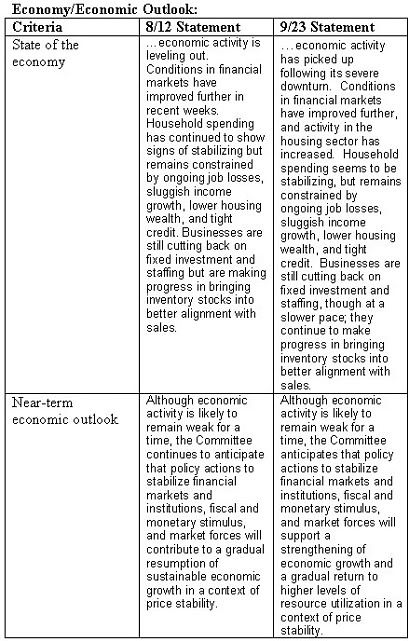
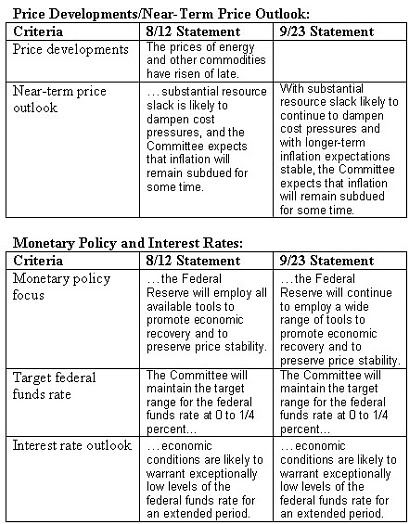
Today, the Federal Reserve’s Federal Open Market Committee (FOMC) left interest rates unchanged. However, the statement explaining its decision indicated that the Federal Reserve now sees the economy in its early stages of strengthening. The Fed has also taken a slightly more robust perspective on near-term economic growth, shifting its language from “a gradual resumption of sustainable economic growth” to “a strengthening of economic growth.” In addition, the FOMC somewhat toned down the language on the Fed’s efforts to promote an economic recovery and maintain price stability. With respect to its extraordinary programs, the Federal Reserve remains on course to end its purchases of Treasury securities in October. In addition, it will extend its purchases of agency mortgage-backed securities and agency debt through the first quarter of 2010. However, it will not expand those programs beyond the earlier announced parameters. The extension of the period during which the Fed will be purchasing such securities has likely been implemented to avoid a sharp cut off of the program.
The following tables compare the FOMC’s August 12 and September 23 monetary policy statements so as to show the continuing evolution of the Fed’s thinking:

&&
The following tables compare the FOMC’s August 12 and September 23 monetary policy statements so as to show the continuing evolution of the Fed’s thinking:
&&
Wednesday, September 16, 2009
U.S. Crude Oil Inventories Continue to Fall
U.S. Crude Oil Inventories Continue to Fall
Consistent with recent seasonality and an emergent economic recovery, U.S. crude oil inventories declined for the forth time in five weeks. The U.S. Energy Information Administration reported that U.S. crude oil inventories had fallen to 332.8 million barrels for the four-week period ended September 11, 2009. All said, U.S. crude oil inventories are now 5.5% lower than the 352.0 million figure for the four-week period ended August 7, 2009. During the same period, U.S. crude oil consumption has increased 2.9%.
With OPEC having decided to leave its production goals unchanged in its most recent meeting, the U.S. and major international economies showing signs of stabilizing or emergent growth, and seasonality continuing to prevail, these developments will very likely preclude a collapse in the price of crude oil predicted by one analyst this year. Instead, oil market fundamentals continue to suggest that any declines would be far shallower. With some recent computer guidance suggesting a possibly colder than normal heating season for populated areas in North America, an increase in crude oil prices as the heating season approaches or commences is plausible.
&&
Consistent with recent seasonality and an emergent economic recovery, U.S. crude oil inventories declined for the forth time in five weeks. The U.S. Energy Information Administration reported that U.S. crude oil inventories had fallen to 332.8 million barrels for the four-week period ended September 11, 2009. All said, U.S. crude oil inventories are now 5.5% lower than the 352.0 million figure for the four-week period ended August 7, 2009. During the same period, U.S. crude oil consumption has increased 2.9%.
With OPEC having decided to leave its production goals unchanged in its most recent meeting, the U.S. and major international economies showing signs of stabilizing or emergent growth, and seasonality continuing to prevail, these developments will very likely preclude a collapse in the price of crude oil predicted by one analyst this year. Instead, oil market fundamentals continue to suggest that any declines would be far shallower. With some recent computer guidance suggesting a possibly colder than normal heating season for populated areas in North America, an increase in crude oil prices as the heating season approaches or commences is plausible.
&&
Wednesday, September 9, 2009
Beige Book: Continuing Economic Stabilization
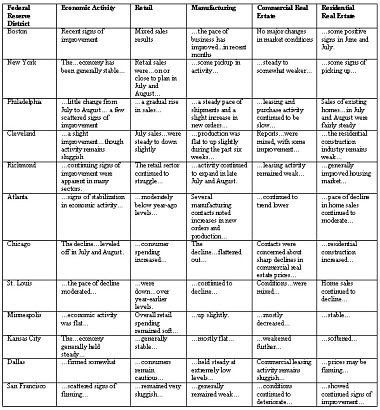
Earlier today, the Federal Reserve released its Beige Book on economic conditions around the nation. The report showed continued stabilization of the overall economy with some indications of improvement. Nevertheless, numerous sectors remained weak.
A table summarizing the report follows:
&&
A table summarizing the report follows:
&&
Friday, August 28, 2009
Bank Failure Snapshot
This evening, the FDIC announced the failure of Baltimore-based Bradford Bank. Bradford is the 82nd bank to fail this year. Since the housing bubble burst, 110 banks have failed. Total assets for those failed banks amount to $465 billion.
Some quick statistics follow:

In addition, three states account for 51 bank failures or 46% of the total to date:
Georgia: 24
Illinois: 14
California: 13
In sum, a quick snapshot reveals:
• The overwhelming majority (79%) of failed banks are small or medium-sized banks.
• The incidence of bank failures has increased markedly during the summer, with July and August accounting for 45% of this year’s failed banks.
• Bank failures have clustered in select states.
&&
Some quick statistics follow:
In addition, three states account for 51 bank failures or 46% of the total to date:
Georgia: 24
Illinois: 14
California: 13
In sum, a quick snapshot reveals:
• The overwhelming majority (79%) of failed banks are small or medium-sized banks.
• The incidence of bank failures has increased markedly during the summer, with July and August accounting for 45% of this year’s failed banks.
• Bank failures have clustered in select states.
&&
Thursday, August 27, 2009
Basel Committee on Banking Supervision Issues Principles for Financial Instrument Accounting Standards
Today, the Basel Committee on Banking Supervision issued a set of principles aimed at guiding the International Accounting Standards Board (IASB) in addressing issues concerning the fair value of financial assets.
Based on the principles, a new accounting standard should:
• reflect the need for earlier recognition of loan losses to ensure robust provisions;
• recognize that fair value is not effective when markets become dislocated or are illiquid.
• permit reclassifications from the fair value to the amortized cost category; which should be allowed in rare circumstances following the occurrence of events having clearly led to a change in the business model;
• promote a level playing field across jurisdictions.
The Basel Committee also noted:
To address particular concerns about procyclicality, the new standards should provide for valuation adjustments to avoid misstatement of both initial and subsequent profit and loss recognition when there is significant valuation uncertainty. Moreover, loan loss provisions should be robust and based on sound methodologies that reflect expected credit losses in the banks’ existing loan portfolio over the life of the portfolio.
&&
Based on the principles, a new accounting standard should:
• reflect the need for earlier recognition of loan losses to ensure robust provisions;
• recognize that fair value is not effective when markets become dislocated or are illiquid.
• permit reclassifications from the fair value to the amortized cost category; which should be allowed in rare circumstances following the occurrence of events having clearly led to a change in the business model;
• promote a level playing field across jurisdictions.
The Basel Committee also noted:
To address particular concerns about procyclicality, the new standards should provide for valuation adjustments to avoid misstatement of both initial and subsequent profit and loss recognition when there is significant valuation uncertainty. Moreover, loan loss provisions should be robust and based on sound methodologies that reflect expected credit losses in the banks’ existing loan portfolio over the life of the portfolio.
&&
Wednesday, August 26, 2009
Seniors’ Health Care Bill of Rights Fails to Satisfy Key Criteria for Credible Health Reform
As outlined in previous blog entries, arguably the most important criteria any credible health care reform initiative would need to satisfy are:
• The initiative would need to be budget-neutral.
• The reform would need to materially slow the annual growth in national health care expenditures.
• The legislation would need to provide a mechanism that significantly reduces the number of uninsured persons.
At the conclusion of its Chapter IV Consultations with the United States, the International Monetary Fund (IMF) noted, in part:
Directors underscored that addressing soaring entitlement costs remains the critical medium-term fiscal challenge… [T]he ultimate package should include substantial measures to reduce health care costs over the longer term, while aiming at budget neutrality in the short term. Directors underscored that the impact of cost control measures will need to be carefully monitored, and that additional measures should be taken promptly as needed.
To date, the Congressional Budget Office (CBO) has found that emerging reform proposals are not budget neutral and they do not bring about a material reduction in the rate at which national health care expenditures have been growing.
On August 24, 2009, Republican National Committee Chairman Michael Steele unveiled a “Seniors’ Health Care Bill of Rights” as an alternative to emerging Congressional packages. Accompanying the concept was an op-ed piece published in that day’s edition of The Washington Post. Together, the conceptual outline and op-ed piece offer a sketch of broader alternative health care reform ideas that are beginning to emerge. However, as was the case with the Congressional initiatives, the alternative ideas also fail to meet the criteria set forth at the beginning of this blog entry.
A closer look at the Steele concept relevant to the aforementioned criteria follows:
Budget Neutrality: In the op-ed piece, Steele writes, “We also believe that any health-care reform should be fully paid for, but not funded on the backs of our nation's senior citizens.” The conceptual outline offers no specific spending reductions or tax increases that would finance health care reform. Consistent with Republican Party principles, tax hikes are likely to be off the table. Therefore, implicit in the concept is the possibility that all spending reductions for health care reform would need to be taken from discretionary spending or that health care reform would have to be shelved altogether.
The former possibility is unlikely to fully finance health care reform that dramatically reduces the incidence of insured persons. As the Steele concept leaves Medicare on auto-pilot and rules out benefit reductions, the rising costs of Medicare could devour an increasing share of discretionary spending, leaving little or nothing for financing any sustainable health care reform initiative. Furthermore, political consensus to achieve increasingly deep discretionary spending cuts is highly unlikely over the longer-term, even as the magnitude of necessary discretionary budget reductions under the Steele approach would grow. Yet, even if health care reform is canceled, the need for health care reform, particularly as the incidence of uninsured persons persists and excess rise in national health care expenditures continues, would grow more urgent.
Slowing the Excess Rise in National Health Care Expenditures: The concept would rule out cuts in Medicare spending. No mention is made about slowing the growth of Medicare spending either. In contrast, even as the Clinton Administration and Republican-led Congress struggled over Medicare reform during the mid-1990s, both sides were in agreement that the rate at which Medicare spending was growing needed to be slowed. Behind the rise in Medicare spending is the slowly shifting demographic mix and health care inflation. Unless health care inflation is tamed—and increasing health industry productivity and focusing on rising hospital-related costs, which have been the principal driver of medical cost inflation could be essential to that task—Medicare expenditures will continue to increase faster than the economy grows. In the long-run, that is a fiscally unsustainable situation.
Significant Reduction in the Incidence of Uninsured Persons: The concept unveiled by Steele is intended to be a starting point for health care reform. It does not address the measures or mechanisms that would be offered to reduce the incidence of uninsured persons.
In sum, even as Steele asserts, “Republicans want reform that should, first, do no harm,” a failure to address Medicare’s long-term fiscal imbalances, which depends in large part on slowing the annual growth in national health expenditures, will inflict growing damage to the nation’s long-term fiscal outlook. Already, the perpetual horizon unfunded liability associated with Medicare amounts to $85.6 trillion. According to Dallas Federal Reserve President Richard Fisher, 97% of discretionary spending, which includes national defense and education spending, would need to be eliminated to finance the nation’s long-term fiscal imbalances associated with Social Security and Medicare. No such stark decision would be politically-feasible. Hence, far from doing “no harm,” a failure to grapple with the fundamental issue of rising health expenditures, which all but certainly will require a mix of revenue increases and benefit reductions, would do great harm.
&&
• The initiative would need to be budget-neutral.
• The reform would need to materially slow the annual growth in national health care expenditures.
• The legislation would need to provide a mechanism that significantly reduces the number of uninsured persons.
At the conclusion of its Chapter IV Consultations with the United States, the International Monetary Fund (IMF) noted, in part:
Directors underscored that addressing soaring entitlement costs remains the critical medium-term fiscal challenge… [T]he ultimate package should include substantial measures to reduce health care costs over the longer term, while aiming at budget neutrality in the short term. Directors underscored that the impact of cost control measures will need to be carefully monitored, and that additional measures should be taken promptly as needed.
To date, the Congressional Budget Office (CBO) has found that emerging reform proposals are not budget neutral and they do not bring about a material reduction in the rate at which national health care expenditures have been growing.
On August 24, 2009, Republican National Committee Chairman Michael Steele unveiled a “Seniors’ Health Care Bill of Rights” as an alternative to emerging Congressional packages. Accompanying the concept was an op-ed piece published in that day’s edition of The Washington Post. Together, the conceptual outline and op-ed piece offer a sketch of broader alternative health care reform ideas that are beginning to emerge. However, as was the case with the Congressional initiatives, the alternative ideas also fail to meet the criteria set forth at the beginning of this blog entry.
A closer look at the Steele concept relevant to the aforementioned criteria follows:
Budget Neutrality: In the op-ed piece, Steele writes, “We also believe that any health-care reform should be fully paid for, but not funded on the backs of our nation's senior citizens.” The conceptual outline offers no specific spending reductions or tax increases that would finance health care reform. Consistent with Republican Party principles, tax hikes are likely to be off the table. Therefore, implicit in the concept is the possibility that all spending reductions for health care reform would need to be taken from discretionary spending or that health care reform would have to be shelved altogether.
The former possibility is unlikely to fully finance health care reform that dramatically reduces the incidence of insured persons. As the Steele concept leaves Medicare on auto-pilot and rules out benefit reductions, the rising costs of Medicare could devour an increasing share of discretionary spending, leaving little or nothing for financing any sustainable health care reform initiative. Furthermore, political consensus to achieve increasingly deep discretionary spending cuts is highly unlikely over the longer-term, even as the magnitude of necessary discretionary budget reductions under the Steele approach would grow. Yet, even if health care reform is canceled, the need for health care reform, particularly as the incidence of uninsured persons persists and excess rise in national health care expenditures continues, would grow more urgent.
Slowing the Excess Rise in National Health Care Expenditures: The concept would rule out cuts in Medicare spending. No mention is made about slowing the growth of Medicare spending either. In contrast, even as the Clinton Administration and Republican-led Congress struggled over Medicare reform during the mid-1990s, both sides were in agreement that the rate at which Medicare spending was growing needed to be slowed. Behind the rise in Medicare spending is the slowly shifting demographic mix and health care inflation. Unless health care inflation is tamed—and increasing health industry productivity and focusing on rising hospital-related costs, which have been the principal driver of medical cost inflation could be essential to that task—Medicare expenditures will continue to increase faster than the economy grows. In the long-run, that is a fiscally unsustainable situation.
Significant Reduction in the Incidence of Uninsured Persons: The concept unveiled by Steele is intended to be a starting point for health care reform. It does not address the measures or mechanisms that would be offered to reduce the incidence of uninsured persons.
In sum, even as Steele asserts, “Republicans want reform that should, first, do no harm,” a failure to address Medicare’s long-term fiscal imbalances, which depends in large part on slowing the annual growth in national health expenditures, will inflict growing damage to the nation’s long-term fiscal outlook. Already, the perpetual horizon unfunded liability associated with Medicare amounts to $85.6 trillion. According to Dallas Federal Reserve President Richard Fisher, 97% of discretionary spending, which includes national defense and education spending, would need to be eliminated to finance the nation’s long-term fiscal imbalances associated with Social Security and Medicare. No such stark decision would be politically-feasible. Hence, far from doing “no harm,” a failure to grapple with the fundamental issue of rising health expenditures, which all but certainly will require a mix of revenue increases and benefit reductions, would do great harm.
&&
Subscribe to:
Posts (Atom)